Physical Address
304 North Cardinal St.
Dorchester Center, MA 02124
Physical Address
304 North Cardinal St.
Dorchester Center, MA 02124
[ad_1]
Quite6:021,900-year-old Roman papyrus details Develop tax evasion scheme
If you think today the world and 2000 years ago, you think you will find several parallels between the world or think that everything is the only person who is dealing with everything for everything.
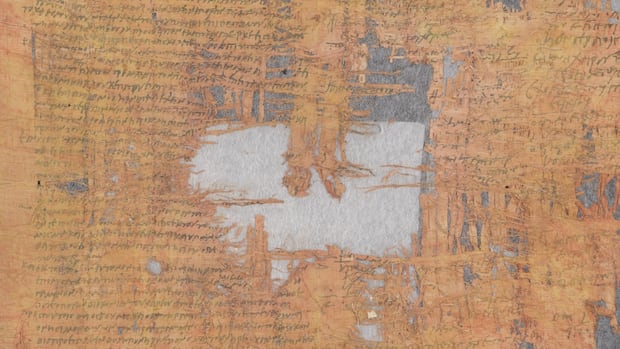
According to a Last analysis of a 1,900-year-old papyrus from the end, ancient RomeThere was tax and tax evasion for Millenia.
“This publish has increased incredibly fortunately, which ended the light,” Anna Dolganov, History of the Roman Empire with the Austrian Archaeological Institute Anna Dolganov said. Quite The host Nile Koksal.
“This is extremely historically important. It is one of the documents that less scientists have begun to work in their careers.”
In the 1950s, Papyrus, in the Judian Desert, contains the tale of two men living in the border between the two Roma provinces. The march written by a prosecutor for preparation for tax evasion, accuses a complex scheme that sanctions of deals after the bondage.
The Roman Empire had at least five types of taxes related to trade, sale, property and scheme. According to research, it shows that four percent taxes related to the earliest evidence, research, five percent taxes of slaves and sanctions.
“As can be seen, they say that the administrative systems of the provinces of Rome are not related to the fact that they do not communicate with each other.
Dolganov says that this was not approved by the other year’s management of the sale of slaves on one side of the border.
“And this seems to receive information about the appearance of servants to be effectively disappearing on paper.”

Two of Dolganov, men, Gadalias and saulos are biblical names that show that they are both Jews.
“The son of a notary that was a means of forgiveness. Thus, he was in his father’s notarial work, and therefore included the tools that need to create fake legal documents.”
The details of the case are seen through the tried objective, which is the criminals who must be convicted of men.
Dolganov said it is possible to make a little background story.
One element of the whole story, Dolganov, Dolganov, one of them suddenly was released by the original owner who did not own the paper.
“If the point is to avoid taxes, why risk managing the servant?
It believes that if the officials are suspicious that something happens.
Dolganov, there are several theories related to men’s motifs outside the trujan tax evasion.
If there were Jewish Masters, the slaves were automatically Jewish and the Jewish law has the requirements that cover the treatment of slaves. It says men are possible that they are trying to avoid their laws.
According to Dolganov, Dolganov said that the accused had human relations with these servants, and the domestic servants who believe in the world of Rome were a habit of rewarding them with tanking.

Tax evading rules were not specific to Jewish subjects. Were universal and extremely hard.
“The Romans did not joke about their tax abandonment. They saw this as a crime against the state, essentially,” Dolganov.
Significant fines of the penalty may include stiff or hard labor in temporary or permanent exile or mines or stone quarries – with the last death.
“In the worst case, an instance of an imaginative way can be executed. For example, the wild animals in the amphitheater can be thrown into the wild animals,” Dolganov.
Dolganov noted that the text said that the Roman legal literature said such cases to work.
“It shows that these border provinces are extremely authorized in this region in this region, and it shows that the legal knowledge of Rome is extremely authorized, and the legal knowledge of Rome is in fact very widespread throughout the empire.”
A History Specialist welcomed the study by saying that it is an effective legal history of the less known period. Papyrus returns to the Jewish people to the threshold of a poorly documented rebellion against the Roman Empire in Judea – a period of time to document researchers.
“I think this is really a pensioner of his voice … This is something that we do not do more than one time and something other than anything else,” said an ancient history professor at the University of Toronto.
He says two aspects of the investigation revealed: the political history of a period in which the slavery in the empire has difficulty accessing historical and historians.
The findings compared to today’s world where taxes are common in goods and services.
“You have to pay a tax when you get a slave, you have to pay taxes when you have a slave, you have to pay a tax while driving, and you have to pay a tax while exporting them,” he said.
“It’s just an activity and it seems to have a tax paything … nice to know some kind of not dealing with everything.”
[ad_2]
Source link
